India’s RuPay & BHIM-UPI may be an option for addressing the Ngultrum Devaluation in the border towns of Jaigaon and Phuentsholing.
After Singapore, Bhutan adopts India’s BHIM-UPI
Bharat Interface for Money (BHIM) is India’s digital payment application (app) that works through UPI, a system that powers multiple bank accounts into a single mobile application.
Finance minister Nirmala Sitharaman launched BHIM-UPI in Bhutan on Tuesday, July 13, 2021. Bhutan became the first country to adopt India’s Unified Payment Interface (UPI) standards for its quick response (QR) code. It is also the second country after Singapore to have BHIM-UPI acceptance at merchant locations through NPCI International Payments Ltd (NIPL).
NPCI is an umbrella organisation for operating retail payments and settlement systems in India. It is an initiative of the Reserve Bank of India and the Indian Banks’ Association to create a robust payment and settlement infrastructure in India.
Finance Minister Nirmala Sitharaman said at the virtual launch of BHIM-UPI in Bhutan that it will help Indian tourists visit “the land of happiness.” “BHIM-UPI is one of the achievements of India in terms of fintech,” she said on the occasion. Prior to the lockdown, over 200,000 tourists from India travelled to Bhutan every year.
Bharat Interface for Money (BHIM) is India’s digital payment application (app) that works through UPI, a system that powers multiple bank accounts into a single mobile application.
During the lockdown because of the COVID-19 pandemic, BHIM-UPI became an “effective mechanism” of payment, and in 2020–21, it processed 22 billion financial transactions worth ₹41 lakh crore, she said.
“It is a proud product of India that we are sharing with Bhutan today,” Sitharaman said. The Unified Payments Interface (UPI) is an instant real-time payment system that allows users to transfer money on a real-time basis across multiple bank accounts without revealing details of one’s bank account to the other party.
The payment system was launched by NIPL, the international arm of the National Payment Corporation of India (NPCI), in partnership with the Royal Monetary Authority (RMA) of Bhutan. The finance minister of Bhutan, Lyonpo Namgay Tshering, was present at the virtual ceremony.
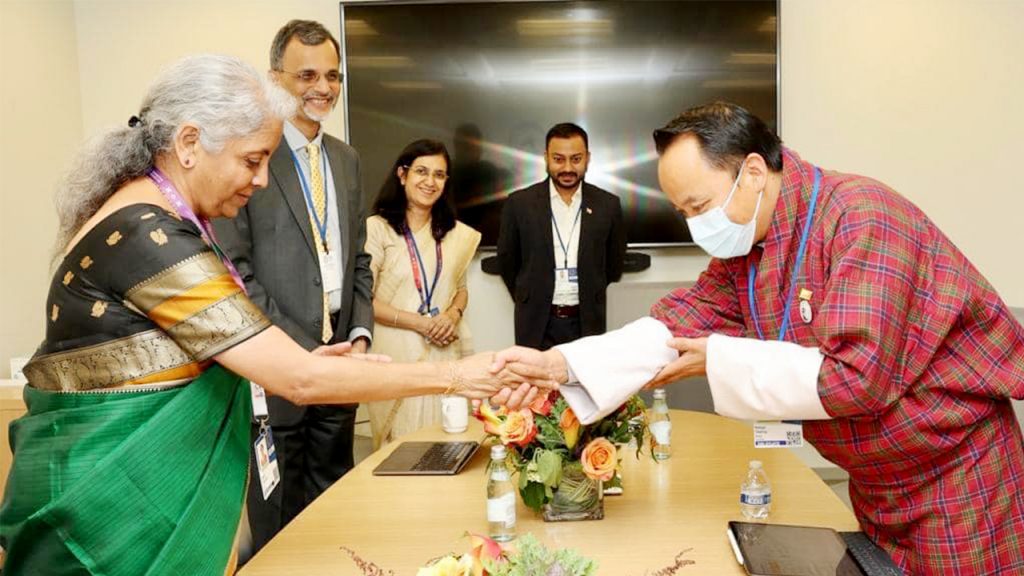
Image credit: Ministerfor Finance, Bhutan (Facebook page)
The collaboration between NIPL and RMA will enable acceptance of the UPI-powered BHIM app in Bhutan. “RMA will ensure that the participating NPCI mobile application through UPI QR transactions is accepted at all RMA acquired merchants in Bhutan,” NIPL said in a statement.
With this launch, Bhutan becomes the first country to adopt UPI standards for its QR deployment, it said. “Bhutan will also become the only country to both issue and accept RuPay cards as well as accept BHIM-UPI,” it added.
“The simple, safe, and cost-effective mobile-based payments system has become one of the most prominent forms of digital payments.” “In 2020, UPI enabled commerce worth $457 billion, which is equivalent to approximately 15% of India’s GDP [gross domestic product],” it said.
“Our vision has always been focused on taking our robust and popular payments solutions to global markets,” said Ritesh Shukla, CEO, NIPL.
This strategic partnership with Bhutan in the area of digital payments will not only enhance the ease of transacting for Indian travellers to Bhutan but will also add value to the lives of customers in Bhutan, he added.
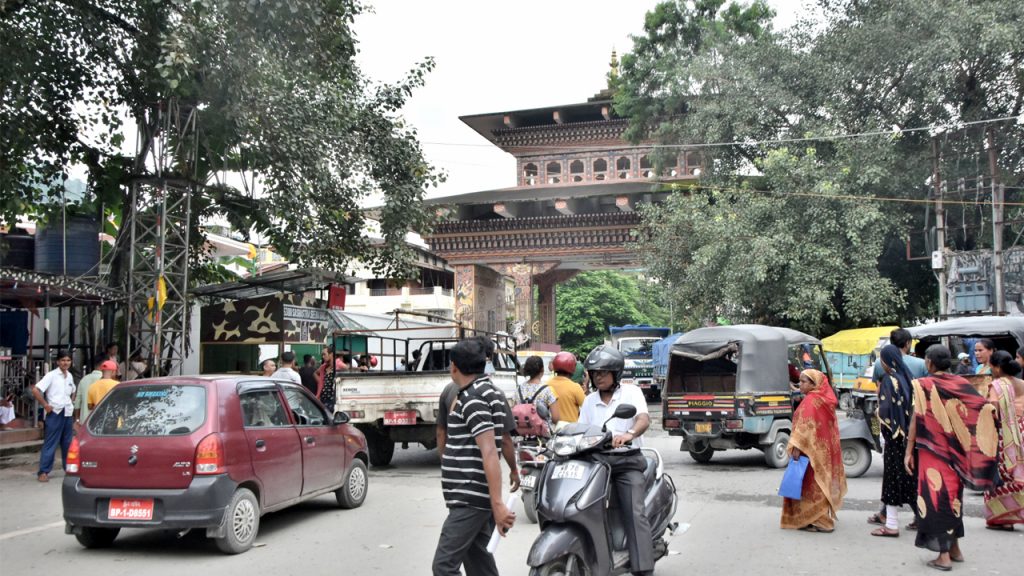
The Devaluation of Bhutanese Ngultrum at Jaigaon
On October 20th, 2022, as per Kuensel, “Ngultrum value drops in Jaigaon,” Rajesh Rai reported, “INR is being traded at 7 to 7.5 percent against Ngultrum. This means an additional Nu 7 to Nu 7.5 is being charged as a commission to buy INR (Rs) 100. This also means the Ngultrum, which is pegged at par with the rupee, is undervalued. “
The rate of exchange is directly related to retail and bulk trade amongst Jaigaon-Phuentsholing people and businesses. More Bhutanese buyers visited Jaigaon, and the surplus of Bhutanese currency accumulated in Jaigaon. During the lockdown period of 2020–2021, the exchange rates went up to 10–12% as the border was sealed by Bhutan and no retail buyers were able to come to Jaigaon.
For decades, illegal exchange-trading in Indian rupees and Bhutanese ngultrum has been practiced. Before lockdown, the illegal exchange rates varied between 1 and 3% per INR 100.
As per a source, more than 1 billion Bhutanese Ngultrum is circulating in the border town of Jaigaon. If not checked, the unaccountable Bhutanese currency reserves in Jaigaon will increase. Some experts say that after the opening of the Bhutan border on September 23, 2022, the cross-border trade and businesses are returning to normalcy, and thus the Ngultrum reserve in Jaigaon may have decreased.
In 2020, to facilitate Jaigaon businessmen, the Royal Government of Bhutan tendered 1.5 billion INR in exchange for Ngultrum. Since then, no such exchange has taken place. Several approaches were made by Jaigaon businessmen and association representatives, but somehow the process was resultless. Some say that the rigid documentation asking for income proof is one of the reasons. As most of them had accumulated Ngultrums by unfair means, they were not in a position to comply with the necessary documentation asked by the Royal Government of Bhutan.
A few pan shops at Jaigaon regulate the commission rates. The unaccountable Ngultrum comes to Jaigaon by unauthorised or illegal means. It is said that Jaigaon exporters undervalue the export items before customs just to avoid taxes. The organised process takes place between Bhutanese importers and Indian exporters. Under-declaration of goods with Jaigaon and Phuentsholing Customs, it benefits both the exporters and importers to make a good profit. The remaining funds are then returned to jaigaon exporters in Ngultrum via various unauthorised channels. Mostly, vegetable importers and a few business owners in Jaigaon act as mediators in providing INRs to pan shops and collecting Ngultrums to send back to Bhutan as payment for imported vegetables and other goods.
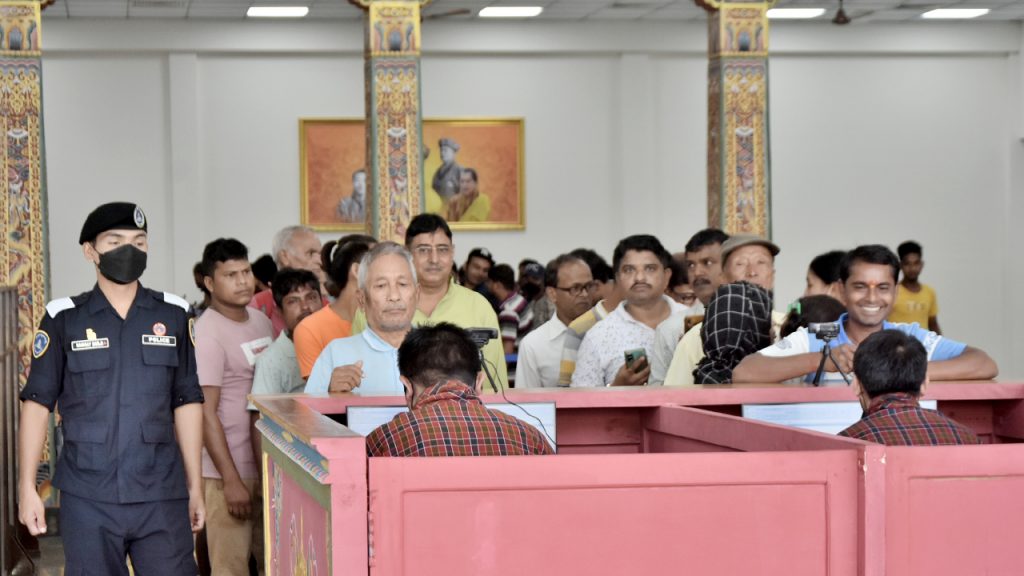
The remedy
BHIM-UPI was introduced in Bhutan in July 2021. The collaboration between NIPL and RMA may further enable Bhutanese buyers to transact and pay to Indian shops electronically using mobile applications like RuPay. This process, if introduced cross-border, will enable Bhutanese buyers to go cashless and thus may, to some extent, control or minimise the Ngultrum devaluation in Jaigaon.
In the present situation, any Bhutanese buyer purchasing goods from retail outlets in Jaigaon ends up paying a 7–7.5% excess if they are transacting in Bhutanese Ngultrums. Jaigaon businessmen readily accept Ngultrum and get them exchanged from pan shops into INR on paying prevailing exchange rates or commissions.
Kuensel reports that “As per the Anti-Money Laundering and Combating the Financing of Terrorism (AML and CFT) Rules and Regulations, 2018, RMA will facilitate INR-Ngultrum exchange in Bhutan for traders across the border if the documents to show the source can be provided.”
——