Bangladesh in Chaos: The Uncertain Future
Introduction
On Monday, August 5, 2024, Bangladesh was thrust into political turmoil as longtime Prime Minister Sheikh Hasina resigned and fled to India under immense pressure from a mass public uprising and the military. Hasina’s abrupt departure, following years of increasingly authoritarian rule, has left the nation of 175 million people facing an uncertain future.
Her resignation marked a significant turning point in Bangladesh’s political history. The 76-year-old leader, daughter of the nation’s founding father, Sheikh Mujibur Rahman, had overseen substantial economic growth during her 15-year tenure. However, her legacy was marred by allegations of human rights abuses, arbitrary arrests, and election manipulation. Now, the country looks to an interim leadership led by Nobel laureate Muhammad Yunus, while tensions rise with questions about the road ahead.
1. The Road to Hasina’s Fall
The sequence of events that led to Sheikh Hasina’s ouster began in early June 2024, when the Supreme Court of Bangladesh reinstated a controversial 30% quota system for government jobs, reserved for the descendants of freedom fighters. This move was seen as a blatant effort to consolidate Hasina’s political base. Young university graduates, already struggling with a youth unemployment rate of 15.7%, perceived the quota as discriminatory, favoring Hasina’s allies while denying equal opportunity to the broader population.
On June 10, 2024, student-led protests erupted across the country, with Dhaka University becoming the epicenter. What began as peaceful demonstrations calling for merit-based job allocation soon escalated into a nationwide movement demanding Hasina’s resignation. Tensions boiled over when Chhatra League, the militant student wing of the ruling Awami League, clashed with protestors on campuses, sparking violent confrontations.
By July 2024, the protests had turned deadly. The regime deployed security forces to suppress the unrest, leading to clashes that left hundreds of protestors dead. Though official numbers from the government placed the death toll at 215, diplomatic sources suggested the real figure exceeded 1,000, sparking outrage across Bangladesh.
2. The July Massacre and Military Intervention
The tipping point came on July 28, 2024, when 215 people were killed in a brutal crackdown dubbed the July Massacre. This tragic event galvanized the nation, with millions of citizens joining the growing movement. By the first week of August, the protests reached unprecedented levels, with millions of demonstrators flooding the streets of Dhaka, demanding an end to Hasina’s regime.
Amid the escalating crisis, General Waker-uz-Zaman, the military chief, issued a statement on August 4, 2024, distancing the armed forces from Hasina’s government. In a televised address, he proclaimed, “The military always stands by the people,” signaling a shift in the balance of power. On the same day, his predecessor, General Ikbal Karim Bhuiyan, condemned the “egregious killings” carried out by Hasina’s security forces, further undermining her authority.
Facing intense pressure from both the military and the masses, Hasina fled Bangladesh on the evening of August 5, 2024, seeking refuge in India. Her departure was confirmed by General Waker-uz-Zaman, who announced the dissolution of parliament and the formation of an interim government.
3. Aftermath of Hasina’s Resignation
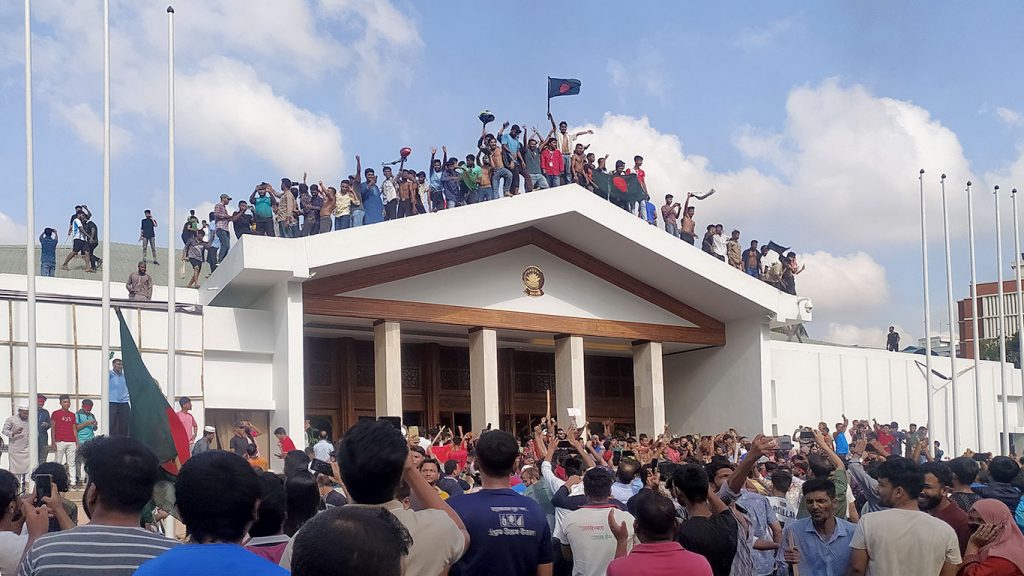
With Hasina gone, Bangladesh entered a period of intense uncertainty. Protesters celebrated the downfall of the regime by storming Ganabhaban, the Prime Minister’s official residence. Mohammad Shahabuddin, the largely ceremonial President of Bangladesh, dissolved the Awami League-controlled parliament and promised to hold fresh elections “as soon as possible.”
In a bid to stabilize the country, Shahabuddin tapped Muhammad Yunus, the 84-year-old Nobel laureate and a well-respected figure among the protestors, to lead an interim government. Yunus, known as the “banker to the poor” for his pioneering work with Grameen Bank, was an outspoken critic of Hasina’s regime and had faced numerous legal battles instigated by her government. His appointment was met with widespread approval from both protest leaders and the international community.
The military also played a significant role in stabilizing the situation. General Waker-uz-Zaman announced the lifting of curfews, restoration of internet services, and the removal of the National Police Chief, signaling a desire for accountability. He promised a full investigation into the killings of protestors and assured the nation that “no army or police will indulge in any kind of firing.”
4. Muhammad Yunus and the Interim Government
Yunus’s rise to interim leadership was the result of negotiations between the student protest leaders, military officials, and President Shahabuddin. Yunus, who was in Paris at the time for a medical procedure, was expected to return to Dhaka to take up his new role. He had long been an adversary of Hasina, who once referred to him as a “bloodsucker” despite his global reputation as a champion for the poor.
Yunus, born in 1940 in Chittagong, was the founder of Grameen Bank, which revolutionized the concept of micro-lending and earned him the Nobel Peace Prize in 2006. His strained relationship with Hasina stemmed from his brief foray into politics in 2007, after which Hasina’s government accused him of corruption and forced him out of Grameen Bank in 2011. Despite these accusations, Yunus remained a popular figure, especially among the younger generation and civil society leaders.
Upon his appointment, Yunus declared, “We’re all rejoicing—the monster who was on top of us has left. Today we are free.” His task, however, was daunting. He would lead a transitional government responsible for conducting free and fair elections and rebuilding a nation scarred by years of autocratic rule.
5. Geopolitical Implications and India’s Role
Hasina’s resignation raised significant geopolitical concerns, particularly for India, her longstanding ally. Throughout her tenure, Hasina maintained a strong relationship with New Delhi, cooperating on counterterrorism, trade, and regional stability. Her sudden departure sent shockwaves through South Asia, prompting concerns that Bangladesh could fall into political chaos or, worse, become a breeding ground for Islamist militancy.
India’s immediate response was to offer Hasina refuge, a move seen by some as a calculated effort to ensure a peaceful transition of power. External Affairs Minister S. Jaishankar expressed confidence that Bangladesh would emerge from the crisis with a democratic government but cautioned against the rise of extremist groups. Intelligence agencies in New Delhi remained on high alert, particularly in border regions, where the potential for militancy and refugee influxes could disrupt stability.
China and Pakistan were also closely watching developments in Dhaka, with fears that a destabilized Bangladesh could upset the delicate balance of power in the region.
6. The Uncertain Future of Bangladesh
As Bangladesh navigates the post-Hasina era, the nation faces significant challenges. The interim government under Yunus must ensure a peaceful transition to democracy while addressing the country’s deep-seated political divisions. Khaleda Zia, Hasina’s longtime political rival and leader of the Bangladesh Nationalist Party (BNP), was released from house arrest on August 6, 2024, adding a new dimension to the political landscape. Though Tarique Rahman, her son and exiled vice-chair of the BNP, has called for restraint, it remains to be seen whether Zia will play an active role in the country’s future.
Meanwhile, the specter of Islamist militancy looms large. Groups like Ansar al-Islam and the Jama’atul Mujahideen Bangladesh (JMB) have exploited the chaos, attacking religious minorities and raising concerns about the country’s future security. The interim government’s ability to quell these threats while restoring democratic governance will define Bangladesh’s future.
Conclusion
The fall of Sheikh Hasina marks a dramatic chapter in Bangladesh’s political history, one defined by mass protests, military intervention, and the rise of a new leadership. As the nation grapples with its uncertain future, the world watches closely to see whether Bangladesh will emerge stronger and more democratic or descend into further chaos. For now, the hope rests on Muhammad Yunus and the young generation that sparked a revolution to bring about lasting change.
***