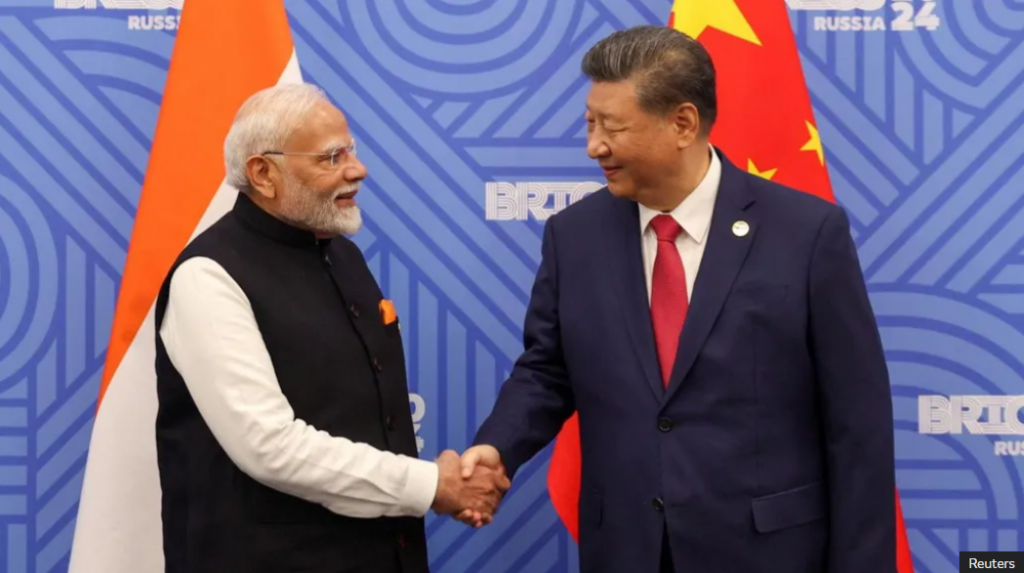
Modi and Xi’s Historic Handshake in Russia: A New Chapter for India-China Relations?
In a historic move that seeks to ease nearly five years of strained relations, Indian Prime Minister Narendra Modi and Chinese President Xi Jinping formally met in Kazan, Russia, on the sidelines of the BRICS summit. This encounter marked their first formal dialogue since 2019 and served as an official endorsement of a recent agreement on disengagement along the disputed India-China border in eastern Ladakh. For both countries, this development, reached through protracted diplomatic negotiations, represents not only a step toward resolving one of the longest standoffs in recent history but also a potentially pivotal turning point in bilateral relations.
Origins and Evolution of the Standoff
The border between India and China, stretching approximately 3,440 kilometers (2,100 miles), has long been a source of tension, compounded by ambiguous boundaries along rivers, lakes, and mountain ranges. Historically, the root of the conflict traces back to a war fought in 1962, resulting in an Indian defeat and an enduring legacy of mistrust. This latent hostility erupted again in 2020 with the deadly Galwan Valley clash, which resulted in the loss of at least 20 Indian soldiers and unconfirmed casualties on the Chinese side. Following this event, both sides intensified their military presence and imposed trade restrictions, with India tightening controls on Chinese investments and banning several Chinese mobile applications. Skirmishes in areas like Sikkim and Tawang further demonstrated the fragile and tense state of India-China relations.
Wednesday’s meeting between Modi and Xi came in the wake of multiple informal dialogues and concerted efforts to disengage at various flashpoints along the Line of Actual Control (LAC). In fact, during the G20 summit in Bali in 2022, the two leaders had an informal “pull-aside” discussion, signaling an early intent to de-escalate tensions. With recent disengagement activities in the Demchok and Depsang regions, the symbolic Modi-Xi meeting in Russia endorsed this commitment to peace and outlined the groundwork for restoring mutual trust.
The “Three Mutuals” and Strategic Diplomacy
Modi’s emphasis during the meeting on “Three Mutuals” — mutual trust, mutual respect, and mutual sensitivity — reflects India’s steadfast approach to rebuilding diplomatic ties with China. This approach seeks not only to address immediate border issues but also to develop a sustainable framework for bilateral relations. The leaders’ decision to appoint Special Representatives (SRs) for renewed discussions, dormant since 2019, underscores the need for an official platform to resolve the boundary dispute. Both countries have recognized that, going forward, cooperation is essential for addressing strategic developmental challenges and advancing their positions as leading nations of the Global South.
China, in its statements, avoided explicitly using the term “agreement,” instead commending the “important progress” made. This choice of language illustrates Beijing’s cautious optimism. Xi Jinping’s remarks further highlighted the importance of ongoing communication, especially in fostering “multi-polarization and democracy in international relations,” aligning with the BRICS vision of a world that reduces dependency on the dollar and promotes economic cooperation among developing countries. By strengthening their positions on multilateral platforms like BRICS, both leaders expressed a commitment to peace and progress as foundational to their respective roles in the global South.
Economic Implications and the Path Forward
The military standoff has not only impacted diplomatic ties but also strained economic relations. Indian businesses have expressed concerns over the stringent restrictions on Chinese investments, citing the adverse effects on high-end manufacturing sectors, including chip production. Although Finance Minister Nirmala Sitharaman has emphasized caution in lifting these restrictions, it is likely that the economic dimension of bilateral relations will be revisited as part of the broader dialogue.
Wednesday’s meeting also suggested that trade might be an indirect beneficiary of the thaw, with both leaders aware that economic synergy is vital to their domestic modernization goals. There has already been progress in areas like civil aviation, with officials from both sides discussing the resumption of direct passenger flights. A gradual relaxation of economic restrictions may follow if diplomatic efforts continue to show positive results.
The Human Cost and Hopes for Stability
The past few years of heightened tensions along the India-China border have exacted a toll not only on the soldiers stationed in these hostile regions but also on the livelihoods of communities reliant on these areas. Incidents like the Galwan clash have left scars that continue to impact soldiers, families, and local communities. The disengagement process, therefore, is as much about diplomatic success as it is about alleviating the human burden of the prolonged standoff.
For the people residing near the LAC, the restoration of peace and the resumption of grazing and agricultural activities signify a long-overdue return to normalcy. Modi and Xi’s statements on the importance of peace and stability reflect this humane aspect, acknowledging that lives and communities should not be collateral in geopolitical conflicts.
A Cautious Optimism for Bilateral Relations
The recent disengagement agreement, endorsed by Modi and Xi, is a crucial first step toward rebuilding trust along the LAC. While there remains a cautious optimism, significant challenges lie ahead. Historical grievances, political maneuvering, and strategic competition continue to influence India-China relations. Nevertheless, with the proposed meeting of SRs and a renewed diplomatic structure, the hope for a peaceful and cooperative future seems more achievable.
For now, the world watches as India and China, representing two of the oldest civilizations and largest developing economies, take tentative steps toward a new chapter in their shared history. The success of this diplomatic thaw may yet serve as a model for handling complex, high-stakes border disputes in a multipolar world.
With inputs from BBC.COM
***