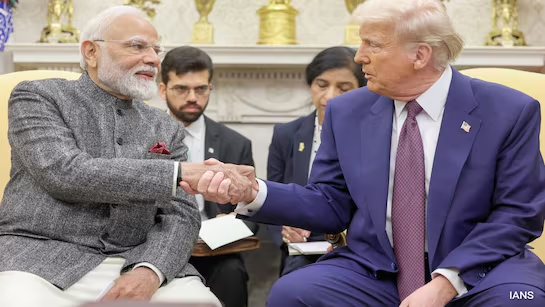
Trump Denies U.S. Deep State Role in Bangladesh Crisis, Defers to Modi
Washington, D.C., February 14, 2025 – U.S. President Donald Trump has firmly dismissed allegations of American involvement in the recent political upheaval in Bangladesh, placing responsibility for the situation under India’s leadership. Speaking at a joint press conference at the White House with Indian Prime Minister Narendra Modi, Trump stated that Bangladesh’s future is for India to manage.
Allegations of U.S. Influence in Bangladesh
The turmoil in Bangladesh, which saw the ousting of former Prime Minister Sheikh Hasina, has fueled speculation about Washington’s role in regime change. Some analysts claim that U.S. agencies, particularly the United States Agency for International Development (USAID), played a part in destabilizing Bangladesh by backing the 2024 student-led movement that ultimately forced Hasina into exile in India.
Former U.S. official Mike Benz has accused Washington of seeking military leverage in the region, possibly aiming to establish a strategic base in Bangladesh. Adding to the speculation, Nobel Laureate Muhammad Yunus, who now heads the interim Bangladeshi government, met with Alex Soros, son of billionaire George Soros, shortly after the Trump administration suspended foreign aid to Bangladesh.
However, Bangladeshi media outlets such as The Dhaka Tribune have challenged these claims, arguing that the alleged U.S. involvement is based on doctored evidence.
Trump’s Response: “Leave Bangladesh to Modi”
When asked about U.S. involvement, Trump categorically denied any “deep state conspiracy,” stating:
“There was no role for our deep state. This is something that the Prime Minister [Modi] has been working on for a long time. I’ll leave Bangladesh to him.”
While Prime Minister Modi did not directly address the Bangladesh issue during the press conference, he later focused on the broader India-U.S. strategic relationship, particularly in the context of the Russia-Ukraine war. Modi praised Trump’s foreign policy and reiterated India’s commitment to regional stability.
India’s Position on the Bangladesh Crisis
Following the bilateral talks, Indian Foreign Secretary Vikram Misri confirmed that Bangladesh was discussed in-depth between Trump and Modi.
“The Prime Minister shared his views and concerns regarding recent developments in Bangladesh and how India perceives the evolving situation,” Misri told reporters. “We hope the situation in Bangladesh progresses in a manner that allows for constructive and stable relations between our two nations.”
India has been closely monitoring the developments in Bangladesh, particularly the reported rise in attacks on religious minorities, including Hindus. Additionally, diplomatic tensions have heightened following Bangladesh’s request for Hasina’s extradition, to which New Delhi has yet to respond.
Strategic Implications for South Asia
The political unrest in Bangladesh has far-reaching consequences for regional security, particularly for India, China, and the U.S.. With China expanding its influence in South Asia, a weakened Bangladesh could become a flashpoint for geopolitical maneuvering.
- For India, the crisis presents both a strategic challenge and an opportunity to exert greater influence in Dhaka.
- For the U.S., Trump’s remarks suggest a policy of disengagement, leaving Bangladesh’s fate largely in Modi’s hands.
- For China, which has been actively courting Bangladesh through infrastructure investments and defense deals, the crisis may provide an opening to strengthen its foothold in the region.
As Bangladesh navigates this period of uncertainty, the role of India and other regional players will be crucial in ensuring that the crisis does not escalate into prolonged instability. Whether India takes a more proactive role in Bangladesh’s internal affairs or maintains a cautious diplomatic approach remains to be seen.
***