25th Round of Boundary Talks Held and Agreement on Joint Technical Team for Border Demarcation Signed Between Bhutan and China
In a significant diplomatic development, the 25th round of boundary talks between the Kingdom of Bhutan and the People’s Republic of China concluded in Beijing on October 23rd and 24th, 2023. The talks led to the signing of an agreement to establish a Joint Technical Team for border demarcation, marking a crucial step in the long-standing Bhutan-China border dispute. This report provides a detailed analysis from the perspective of Indian geopolitics and its implications for regional stability. It also includes additional details provided by the Ministry of Foreign Affairs and External Trade of Bhutan.
Background
The Bhutan-China border dispute, particularly concerning the Doklam region, has long been a matter of concern for India. India maintains a close and strategic partnership with Bhutan and has a vested interest in ensuring the peaceful resolution of this dispute.
In 2020, China made a claim on Sakteng Wildlife Sanctuary in Bhutan at the Global Environment Facility (GEF) Council, which prompted a demarche from Bhutan to the Chinese Embassy in India.
China has also intensified efforts to develop villages along its borders with India, Bhutan, and Nepal, focusing on infrastructure development and preferential policies.
Key Developments:
1. India’s Stake: From an Indian perspective, the successful conclusion of the 25th round of talks and the establishment of a Joint Technical Team are viewed as positive steps towards a peaceful resolution of the Bhutan-China border issue. India’s concerns stem from the proximity of the Doklam region to its own borders. Any escalation in the dispute could potentially lead to increased tensions and security challenges in the region.
2. Reduced Security Concerns: The constructive atmosphere and mutual cooperation witnessed during the talks reduce the immediate security concerns for India. A peaceful resolution between Bhutan and China is in India’s interest as it promotes stability along its northern borders.
3. Geopolitical Significance: The resolution of the Bhutan-China border dispute is geopolitically significant for India. It showcases the importance of diplomacy and peaceful negotiations in addressing territorial disputes, setting a positive precedent for addressing similar issues in the region.
4. Regional Implications: Stability in the Bhutan-China border region directly impacts the overall security and stability of South Asia. As India shares a long border with China, peaceful resolution in Bhutan can help reduce tensions in the wider region, fostering a climate of cooperation over confrontation.
5. China’s Role: India remains watchful of China’s role in the Bhutan-China talks. A diplomatic solution is preferred over any unilateral actions, and India hopes that China continues to engage in constructive negotiations.
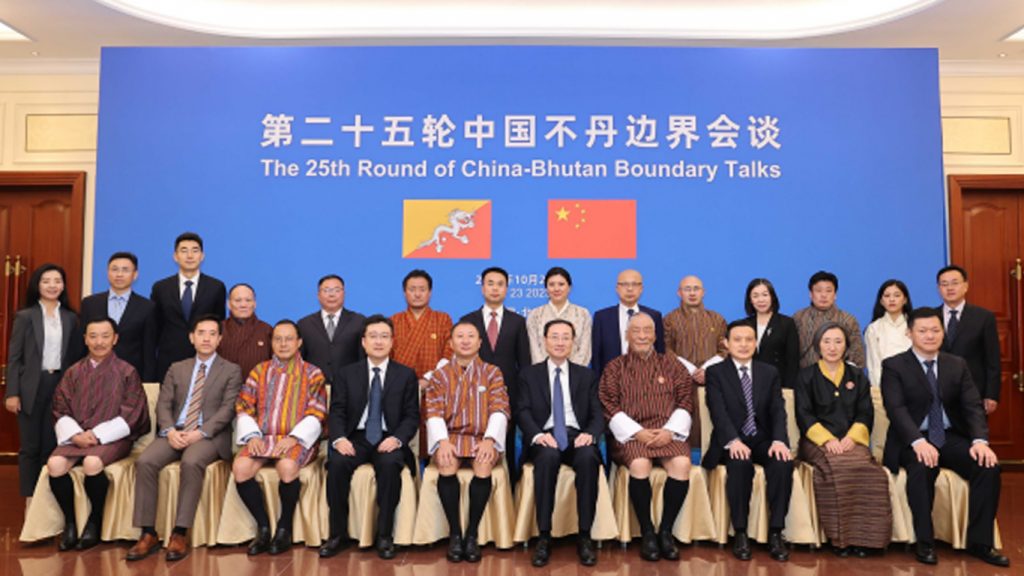
The Ministry of Foreign Affairs and External Trade of Bhutan provided the following key details:
– The 25th Round of Boundary Talks took place in Beijing on October 23rd and 24th, 2023, highlighting the commitment of both sides to engage in constructive dialogue.
– Lyonpo (Dr) Tandi Dorji, Minister for Foreign Affairs and External Trade of Bhutan, led the Bhutanese delegation, while Mr. Sun Weidong, Vice Foreign Minister of China, led the Chinese delegation.
– The discussions during the talks highlighted the progress made through a series of Expert Group Meetings since the 24th Round of Boundary Talks in 2016. Both delegations commended the Expert Group for their work and agreed to build on the positive momentum.
– During the talks, the two leaders of the delegations signed the Cooperation Agreement on the Responsibilities and Functions of the Joint Technical Team on the Delimitation and Demarcation of the Bhutan-China Boundary. The JTT was established during the 13th Expert Group Meeting to assist in the implementation of the Memorandum of Understanding on the Three-Step Roadmap.
– The two sides agreed to continue working together to simultaneously push forward the implementation of all the steps of the Three-Step Roadmap, highlighting their commitment to resolving the border dispute peacefully.
– The discussions were held in a warm and friendly atmosphere, reflecting the strong ties of friendship and cooperation between Bhutan and China.
– Additionally, Lyonpo (Dr.) Tandi Dorji had meetings with Mr. Han Zheng, Chinese Vice President, and Mr. Wang Yi, Member of the Political Bureau of the CPC Central Committee and Minister for Foreign Affairs of China. The Bhutanese delegation also visited places of historical and cultural significance during their visit to China.

International Response
The international community has welcomed the Bhutan-China talks and the establishment of the Joint Technical Team, recognizing the potential for regional stability and the importance of peaceful dispute resolution in a volatile region.
From an Indian geopolitical perspective, the 25th round of boundary talks between Bhutan and China, along with the agreement to create a Joint Technical Team, holds immense significance. The constructive dialogue and cooperation witnessed in Thimphu and Beijing reduce immediate security concerns for India and promote stability along its northern borders. Furthermore, this development sets a positive precedent for peaceful conflict resolution in the region, and India hopes that China will continue to engage in a diplomatic and cooperative manner. The international community’s support for these talks underscores the broader importance of resolving territorial disputes peacefully, which is crucial for regional stability and security in South Asia.
***