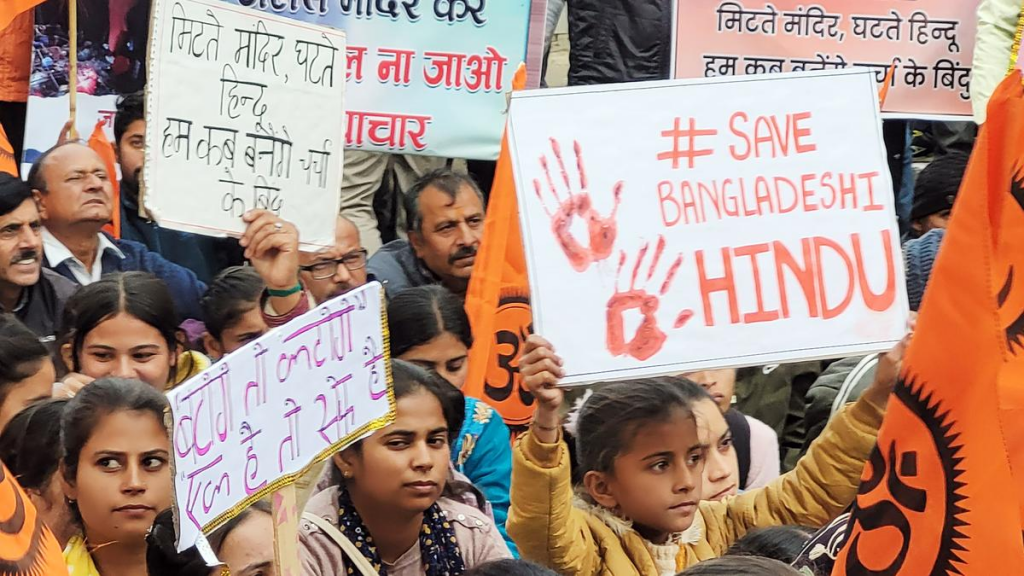
Attacks on Religious Minorities in Bangladesh: A Political, Not Communal Crisis
A recent report by the Bangladesh Police has revealed that the majority of the 1,769 incidents of violence against religious minorities since August 2024 were politically motivated rather than communal. This finding has sparked concerns from neighboring India, which has questioned the credibility of Bangladesh’s interim government in protecting minority rights.
Majority of Attacks Linked to Political Unrest
On January 11, 2025, the Bangladesh Police released a comprehensive report addressing allegations of violence against religious minorities, including Hindus, Buddhists, and Christians. The data, sourced from the Bangladesh Hindu Buddhist Christian Unity Council (BHBUC), indicated that out of 1,769 reported cases, 1,234 were politically motivated, only 20 were communal, and 161 were deemed false.
A significant surge in violence was recorded around the political upheaval following the ousting of former Prime Minister Sheikh Hasina on August 5, 2024. On that single day, 1,452 incidents occurred, with additional acts of violence reported on August 4 and 6, underscoring the volatile political climate as a major factor.
Interim Government’s Response Under Scrutiny
The interim government, led by Nobel laureate Muhammad Yunus, has maintained a “zero-tolerance” policy towards communal violence. The Chief Adviser’s Press Wing highlighted several measures taken, including the investigation of complaints, the filing of 62 cases, and the arrest of 35 individuals. Additionally, a WhatsApp hotline was introduced to facilitate direct reporting from minority communities.
Despite these efforts, the government has faced criticism for its initial reluctance to acknowledge the scale of the attacks and for delays in responding effectively. Law enforcement officials admitted to delays in addressing concerns from minority communities, attributing these to the instability that followed the political transition.
India Expresses Deep Concern
India has voiced strong concerns over the situation, with officials criticizing the interim government’s downplaying of the attacks and the lack of swift justice. A senior Indian official questioned, “How does political motivation justify any killings or attacks on minorities? This raises serious questions about the credibility of the interim government.”
India’s apprehensions intensified following the arrest of Hindu monk Chinmoy Krishna Das on sedition charges. During his visit to Dhaka in December 2024, Indian Foreign Secretary Vikram Misri urged the Bangladeshi government to ensure justice for the victims and to implement stronger measures to prevent further violence.
A Fragile Narrative and Systemic Vulnerabilities
While the police report marks a shift from the interim government’s earlier dismissal of such incidents as exaggerated, experts argue that politically motivated violence can still carry communal undertones, particularly when minority groups are disproportionately targeted. Reports of temple vandalism and attacks on minority properties reflect deep-rooted vulnerabilities within the system.
The political instability following Sheikh Hasina’s ouster has further strained Bangladesh’s law enforcement capacity. Although promises of compensation and increased security have been made, rebuilding trust among minority communities remains a significant challenge.
A Call for Accountability
Acknowledging the politically motivated nature of these attacks is a step forward for the Bangladesh government. However, without decisive action to ensure justice, prevent future incidents, and restore confidence among minority communities, these efforts will remain inadequate.
India’s concerns highlight the broader regional implications of minority suppression. A transparent, inclusive approach by Bangladesh’s interim government is essential to maintain its credibility and address international apprehensions. Failure to act decisively risks not only eroding human rights but also destabilizing the country’s socio-political fabric.
***