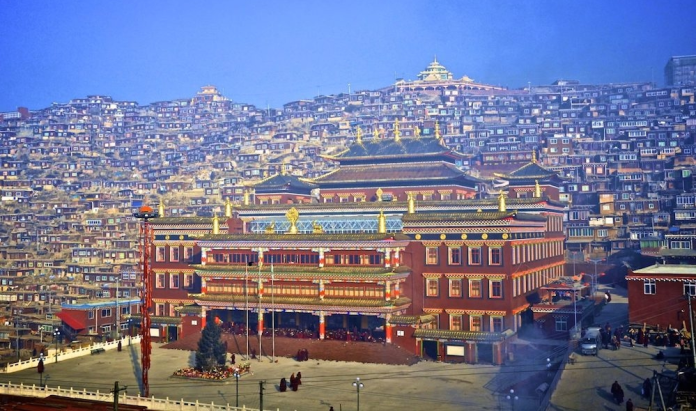
China Intensifies Crackdown on Tibetan Buddhism: Over 1,000 Monks and Nuns Expelled from Larung Gar
February 14, 2025 – In a renewed clampdown on Tibetan Buddhism, Chinese authorities have expelled over 1,000 monks and nuns from the Larung Gar Buddhist Academy in Serthar County (Seda in Chinese), Sichuan Province. The move, accompanied by demolition of monastic residences, further weakens one of the most significant centers for Tibetan Buddhist learning.
This latest mass expulsion is part of China’s ongoing efforts to curb religious influence and enforce strict ideological control. The crackdown follows earlier waves of repression, including the forced eviction of over 4,500 monks and nuns and the destruction of 1,000 monastic quarters between 2016 and 2017.
China’s Systematic Repression of Tibetan Buddhism
According to reports, 400 Chinese troops were deployed to Larung Gar on December 20, 2024, with helicopter surveillance monitoring the operation. The Central Tibetan Administration (CTA), based in Dharamshala, India, confirmed that new, stringent residency rules are being introduced. These include:
- A 15-year limit on monastic studies
- Mandatory registration of all monks and nuns
- Restricted entry for non-residents
Human rights watchdog Tibet Watch reported that demolition work began in late November 2024 and is still ongoing. Unlike previous crackdowns, Chinese authorities have imposed a media blackout, preventing the circulation of images or videos. Sources indicate that expelled monks and nuns were forcibly removed for “lacking proper residency documentation”, and their former living quarters have been marked for demolition.
Additionally, China plans to build a road through the monastery in April 2025, raising fears of further state encroachment.
Regional and Geopolitical Implications
China’s crackdown on Tibetan Buddhism carries serious implications for neighboring countries, particularly India, Nepal, and Bhutan.
- India, home to the Tibetan government-in-exile and the Dalai Lama, has long criticized China’s repressive policies in Tibet. With the latest expulsion, New Delhi may face increased pressure to advocate for greater international scrutiny of Beijing’s actions.
- Nepal, under growing Chinese influence, has already faced diplomatic pressure to restrict Tibetan activism within its borders.
- Bhutan, with its deeply rooted Buddhist traditions, remains cautious in its geopolitical balancing act with China.
By systematically reducing Larung Gar’s population and influence, China is not just limiting religious freedom, but also erasing Tibetan cultural and spiritual identity.
Beijing’s Push for ‘Sinicization’ of Tibetan Buddhism
China’s “Sinicization” policy—aimed at restructuring all religions to align with Communist Party ideology—is at the heart of these crackdowns. Tibetan monasteries, long viewed as centers of resistance and identity, are facing increased scrutiny. Beijing argues that these measures promote “social stability”, but Tibetan activists and human rights groups see them as a deliberate attempt to erase Tibetan identity.
With global attention focused on other geopolitical conflicts, Tibet remains one of the most heavily restricted regions in the world. The critical question now is whether the international community—especially India and its allies—will push back against China’s suppression of Tibetan Buddhism, or allow Beijing’s encroachment to go unchallenged.
***