Bhutan’s Balancing Act: Navigating Diplomacy, Democracy, and Regional Realities
In a nuanced tapestry of international diplomacy and domestic democracy, Bhutan finds itself at a pivotal juncture, navigating a royal visit to India amidst ongoing China-Bhutan border talks and a transformative election landscape.
Royal Visit and Bilateral Commitments:
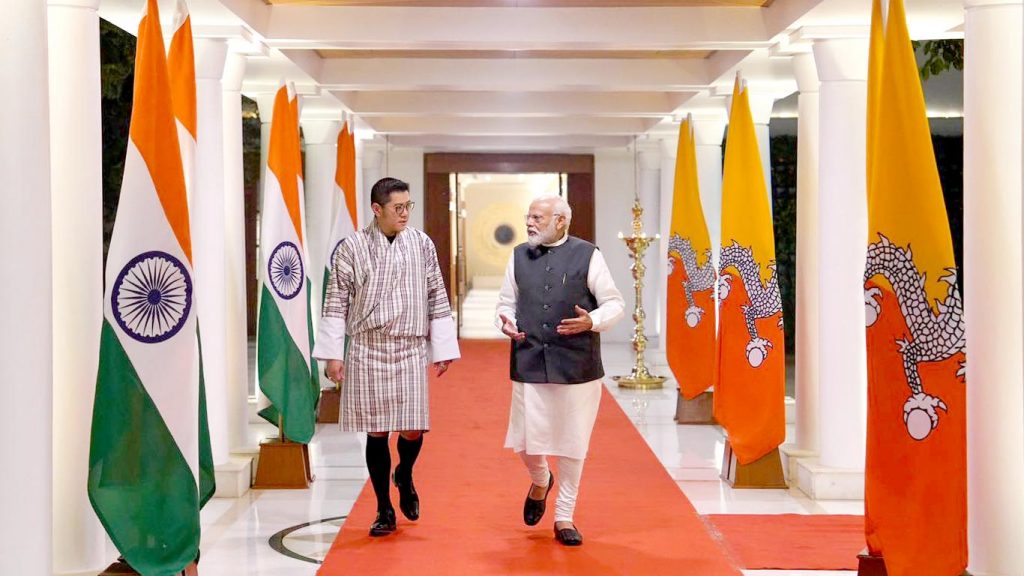
Against the backdrop of the Himalayas, King Jigme Khesar Namgyel Wangchuck’s visit to India on November 6th serves as a reaffirmation of the enduring bonds of friendship and cooperation between Bhutan and India. The leaders, King Wangchuck and Prime Minister Narendra Modi, underscored the exceptional trust characterizing their bilateral ties. A comprehensive joint statement unveiled a roadmap for cooperation, including proposed cross-border rail links, immigration check-posts, and additional railway trade routes.
Border Talks and Strategic Balance:
The visit gains added significance in the context of the ongoing China-Bhutan border talks. As Bhutan assures India of considering its interests in any border agreement with China, the geopolitical balance in the region takes center stage. India emphasizes the 2012 understanding regarding the finalization of tri-junction boundary points through consultation with concerned countries, reflecting strategic concerns amid the delicate diplomatic ballet.
Election Dynamics and Political Transition:
Simultaneously, within Bhutan’s borders, the democratic spirit is alive as citizens engage in the fourth free vote since the establishment of democracy 15 years ago. The Election Commission of Bhutan (ECB) reports a seismic shift in political dynamics with the People’s Democratic Party (PDP) securing the highest votes in the preliminary round, closely pursued by the Bhutan Tendrel Party (BTP). As the outgoing ruling party steps aside, new contenders, each with distinct visions, emerge onto the political stage.
Party Profiles and Common Objectives:
The PDP, led by former Prime Minister Tshering Tobgay, brings experience and a liberal ideology, having governed Bhutan from 2013 to 2018. On the other hand, the BTP, a nascent force formed in 2022 by former bureaucrat Pema Chewang, injects fresh perspectives into Bhutanese politics. Both parties converge on the need for increased investment to bolster the $3 billion economy, focusing on hydro-electric power, agricultural growth, and unemployment alleviation.
Final Round and Future Trajectory:
With the ECB inviting PDP and BTP to nominate candidates for the final round on January 9, Bhutanese citizens find themselves at a crossroads of political choices. The outcomes will not only shape the future leadership but also influence Bhutan’s regional trajectory. As the delicate dance of diplomatic engagements and democratic transitions unfolds, Bhutan remains a focal point of regional dynamics and international scrutiny, with implications for the broader geopolitical landscape in the Himalayan region.
***